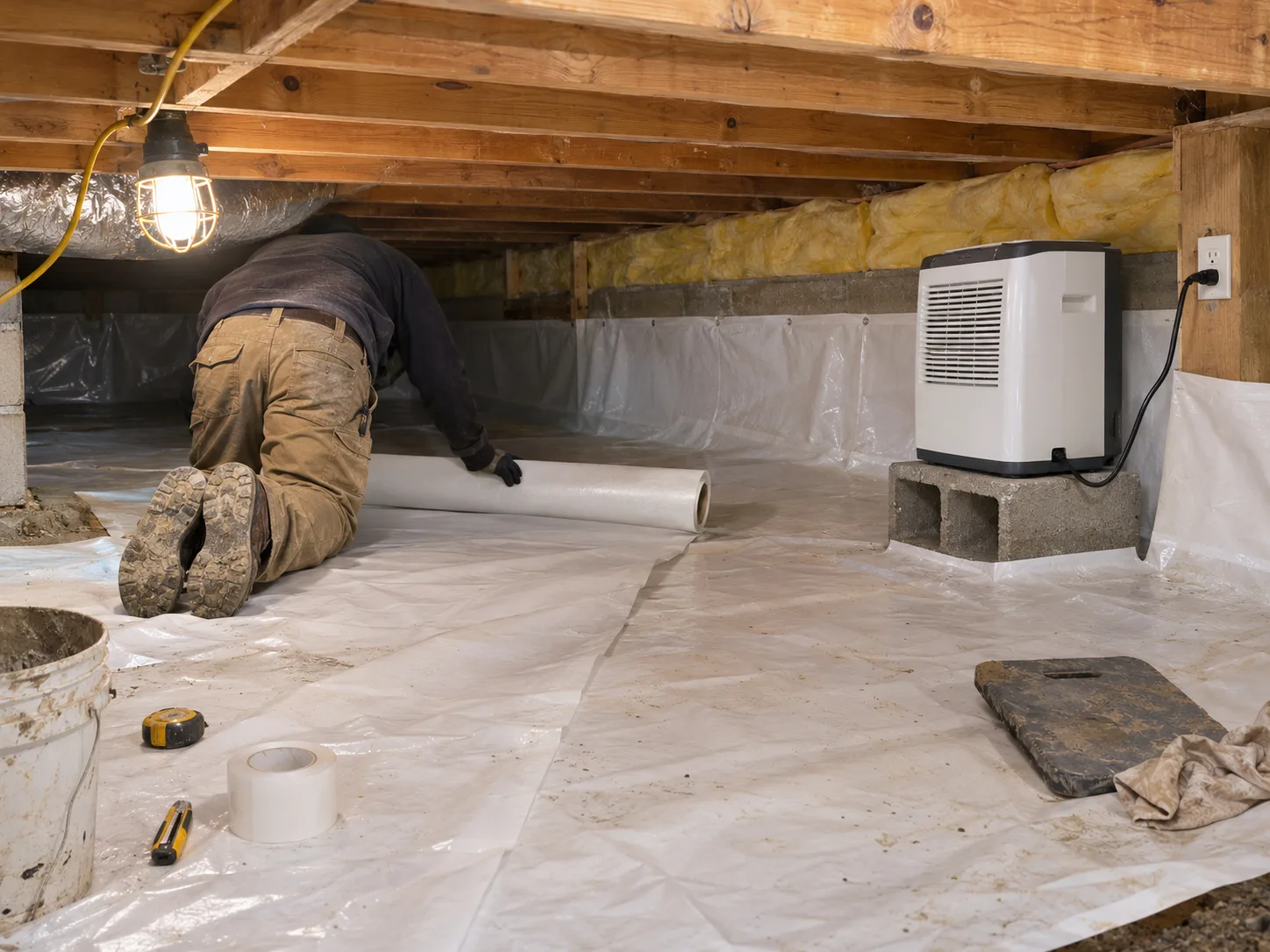
Most crawl space calls in Dunmore come from one of three things: visible mold on the joists, rotted subfloor in an upstairs bathroom or kitchen, or a high-radon test result that the homeowner needs to pass for a resale closing. The root cause is almost always the same, which is open ground vents and a dirt floor allowing 24-hour-a-day moisture migration up into the wood framing. Fifty inches of annual snow and a wet April in Lackawanna County turn an open crawl space into a 95 percent relative humidity sauna from March through November. Wood holds that moisture, mold spores find it, and framing rots from the bottom up.
A proper encapsulation seals the crawl space from the outside and treats it like conditioned interior space. We start with a 20 mil reinforced polyethylene vapor barrier run across the full dirt floor and up the foundation walls, overlapped 12 inches at every seam and taped with a butyl-based seam tape. The barrier gets mechanically fastened to the wall with concrete anchors and sealed to the perimeter with urethane caulk. Twenty mil is important for Dunmore because contractor-grade 6 mil plastic gets punctured in 2 years by anyone crawling under the house to run a cable or plumbing line.
The dehumidifier is the engine that keeps the encapsulation working. We spec Santa Fe or Aprilaire commercial grade units sized for the square footage of the crawl, with a built-in condensate pump that ties into the perimeter drain or an existing sump. A properly sized dehumidifier pulls the relative humidity down to 45 to 55 percent and holds it there year-round, which is below the threshold where mold grows and wood rots. Residential units sold at the big box stores are not rated for the dust and temperature range of a crawl and burn out in 18 months. Commercial units run 10 to 15 years and are worth the extra 1,500 dollars.
Perimeter rim joist insulation is the last critical piece that most installers skip. The band of framing where the first floor subfloor meets the foundation wall is the single biggest energy loss point in a Dunmore crawl space and also the single wettest condensation surface in January when 20 degree air meets warm humid wood. We spray 2 inches of closed-cell foam onto the rim joist cavity, which seals the air leak and adds R-14 of insulation. Rim joist spray adds 800 to 2,000 dollars to a full encapsulation and cuts the winter heating bill by 8 to 15 percent on most Dunmore houses.
What we handle
Full Crawl Space Encapsulation
20 mil reinforced vapor barrier on floor and walls, mechanically fastened and sealed, vent closures, perimeter drain tie-in, commercial dehumidifier with condensate pump, rim joist closed-cell foam. The complete package for a Dunmore crawl under 1,500 square feet.
Vapor Barrier Install Only
For homeowners doing a staged project on a tighter budget. We install the 20 mil barrier on the floor and walls first, with all the seams taped and the wall sealed. Dehumidifier and insulation can be added later.
Crawl Space Drainage and Sump Install
For wet crawl spaces where standing water pools during rain. Interior perimeter drain in washed stone tied to a dedicated sump pit and pump. Standard precursor to any encapsulation on an actively wet crawl.
Commercial Dehumidifier Install
Santa Fe or Aprilaire crawl-rated unit sized to the cubic footage, with condensate pump and built-in humidistat. Holds the crawl at 45 to 55 percent relative humidity year-round.
Rim Joist Closed-Cell Foam Insulation
2 inches of closed-cell spray foam on the perimeter band joist. Seals the air leak, adds R-14 of insulation, and stops January condensation on cold framing. Pays itself back in 3 to 5 heating seasons.
Mold Remediation and Joist Treatment
HEPA-vac mold spores off joists and subfloor, apply a borate-based wood preservative to stop future growth, encapsulate and let the conditioned environment do the rest. We refer out any structural rot repair to a trusted framing carpenter.
Radon Mitigation Tie-In
An encapsulated crawl is a huge first step on radon, but some NEPA homes still need an active sub-slab or sub-membrane depressurization fan. We install a sealed suction point under the vapor barrier and route the vent stack through the roof.
How the job goes
1. Free Phone Intake
You call, we ask crawl size, access type (interior hatch, exterior door), current condition (dry, damp, standing water), and whether a radon test has been run. You get a price band and encapsulation scope recommendation inside 15 minutes.
2. On-Site Inspection
Foreman crawls the full space with a flashlight, measures square footage and ceiling height, photographs joist condition, logs any active water entry points. Full inspection takes 45 to 75 minutes.
3. Written Scope and Flat-Rate Quote
Vapor barrier square footage, drain linear footage if needed, dehumidifier size, rim joist foam, mold treatment. All written, flat-rate, before any work starts.
4. Prep, Drainage, Encapsulate
Clear debris, HEPA-vac if mold is present, install drainage and sump if needed, roll out the vapor barrier, overlap and tape seams, mechanical fasten to wall. Rim joist foam goes in last. Full encapsulation of a 1,000 square foot crawl finishes in 2 to 3 working days.
5. Dehumidifier Startup and Warranty
Set the dehumidifier, program the humidistat to 50 percent, verify condensate drainage. Walk you through the maintenance (filter every 6 months). Written transferable workmanship warranty and photo set of every inch of installed barrier.
What's included
- Free on-site inspection with photos of crawl condition
- 20 mil reinforced polyethylene vapor barrier, not 6 mil contractor plastic
- 12 inch overlap and butyl seam tape at every joint
- Mechanical wall fastening with concrete anchors and urethane sealant
- Commercial-grade crawl-rated dehumidifier with condensate pump
- Closed-cell rim joist foam at R-14 minimum where specified
- HEPA-vac mold remediation and borate wood treatment as needed
- Transferable workmanship warranty and full photo documentation
What it costs
Most crawl space encapsulations in Dunmore run 5,500 to 14,000 dollars complete. Vapor barrier only jobs run 2,500 to 5,000 dollars. Commercial dehumidifier add-on alone runs 1,800 to 2,800 dollars installed.
| Job | Typical price | Notes |
|---|---|---|
| Full Crawl Space Encapsulation | $5,500 to $14,000 | 20 mil vapor barrier floor and walls, taped seams, mechanical fasten, dehumidifier, condensate pump, rim joist foam. Priced by square footage and complexity. |
| Vapor Barrier Only Install | $2,500 to $5,000 | Floor and wall barrier taped and sealed, no dehumidifier or foam. Good first-stage fix on a tighter budget. |
| Commercial Dehumidifier Install | $1,800 to $2,800 | Santa Fe or Aprilaire crawl-rated unit sized to the space, with condensate pump tied to a sump or drain. Add-on to an existing encapsulation. |
| Crawl Space Drainage and Sump | $3,500 to $7,500 | Interior perimeter drain in washed stone, dedicated sump pit and pump. Needed before any encapsulation on an actively wet crawl. |
| Rim Joist Closed-Cell Foam | $800 to $2,000 | 2 inches of closed-cell spray foam on the band joist. Priced per linear foot of perimeter. |
| Free On-Site Inspection and Quote | Free | Full crawl walk with flashlight and camera, photographed joist and barrier condition, written flat-rate quote in your hand before we leave. No service call fee. |
Ranges are typical for Crawl Space Encapsulation jobs in Dunmore and confirmed with an exact written quote before any work starts.